

Wholesale Distribution – Impact on UK Business Procurement
Finding reliable suppliers for catering and hospitality operations across the United Kingdom often means juggling delivery schedules and fluctuating costs. Wholesale distribution plays a vital role in connecting mid-sized businesses with essential goods, helping smooth out daily procurement challenges. With the UK wholesale sector valued at £29 billion and supporting around 60,000 jobs, this article explores how targeted distribution models can simplify sourcing and enhance efficiency for operational supplies.
Table of Contents
- Defining Wholesale Distribution In The UK
- Types Of Wholesale Distribution Channels
- Key Wholesale Processes And Operations
- Legal Framework And Industry Regulations
- Risks, Costs, And Procurement Best Practices
Key Takeaways
| Point | Details |
|---|---|
| Importance of Wholesale Distribution | The UK wholesale distribution sector is essential for linking manufacturers and businesses, valued at approximately £29 billion with significant employment. |
| Diverse Distribution Channels | Four primary channels—Traditional Wholesale, Drop Shipping, Cash-and-Carry, and Exclusive Distribution—provide flexibility to meet varied business procurement needs. |
| Strategic Operational Processes | Effective inventory management, procurement, and warehousing are fundamental to successful wholesale operations, supported by advanced technology integration. |
| Regulatory Compliance | Businesses must navigate a complex legal landscape and regularly review their distribution agreements to ensure compliance with evolving regulations. |
Defining Wholesale Distribution in the UK
Wholesale distribution represents a critical infrastructure connecting manufacturers and businesses across the United Kingdom, enabling efficient product movement through strategic intermediary channels. At its core, this economic mechanism involves bulk purchasing, storage, and redistribution of goods to various commercial entities, ranging from independent retailers to large hospitality organisations.
The UK wholesale distribution sector plays a significant economic role, supporting diverse business ecosystems through sophisticated supply chain networks. Valued at approximately £29 billion and employing around 60,000 professionals, this sector facilitates seamless product transfers between production points and end-user businesses. Wholesale distributors act as essential intermediaries, managing inventory, managing logistics, and providing critical market access for numerous product categories.
Key characteristics of wholesale distribution in the United Kingdom include strategic product aggregation, efficient transportation mechanisms, and comprehensive inventory management. Businesses leverage these distribution networks to access bulk purchasing opportunities, reduce individual procurement complexities, and optimise operational supply chains. Wholesale distributors often specialise in specific industry segments, such as catering supplies, office equipment, or specialised commercial products, allowing for targeted and precise product delivery.
Pro tip: When selecting a wholesale distribution partner, evaluate their industry specialisation, delivery reliability, and product range diversity to ensure optimal procurement efficiency.
Types of Wholesale Distribution Channels
Wholesale distribution encompasses multiple strategic channels designed to meet diverse business procurement needs across the United Kingdom. Distribution models vary significantly depending on product complexity, market requirements, and operational strategies, offering businesses flexible approaches to sourcing and supply chain management.
Four primary wholesale distribution channels dominate the UK market. Traditional wholesale involves bulk purchasing from manufacturers and reselling to retailers, providing a straightforward supply mechanism. Drop shipping represents a modern approach where wholesalers transfer customer orders directly to manufacturers or suppliers, eliminating inventory storage costs. Cash-and-carry models enable businesses to purchase goods in bulk from dedicated warehouse facilities, collecting and transporting products independently. Exclusive distribution grants specific distributors sole regional rights, ensuring controlled market penetration and maintaining brand integrity.
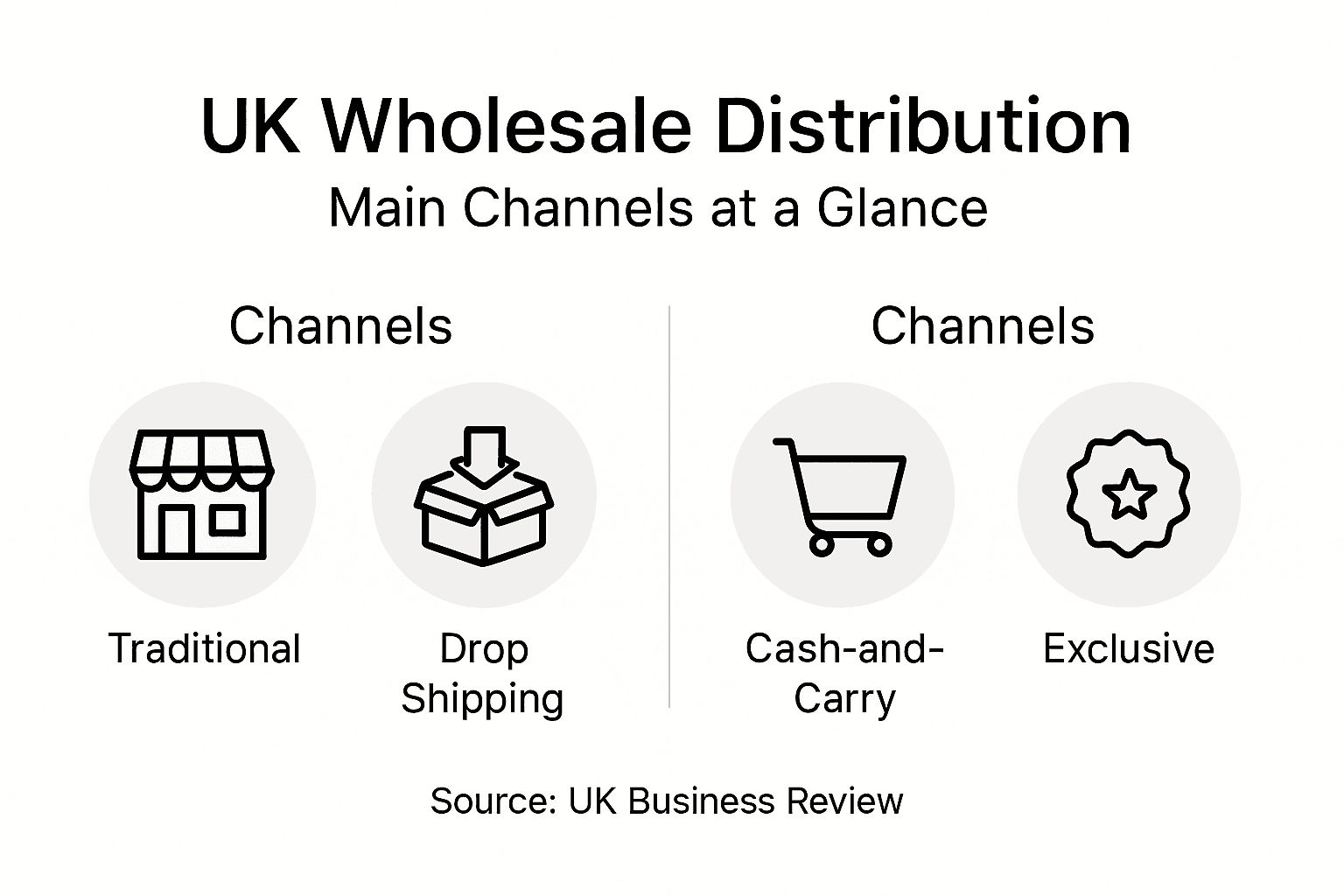
Each distribution channel presents unique advantages for different business contexts. Traditional wholesale suits organisations requiring consistent inventory control, while drop shipping benefits businesses seeking minimal upfront investment. Cash-and-carry models provide maximum flexibility for smaller enterprises, and exclusive distribution ensures premium brands maintain stringent quality standards. Procurement professionals must carefully evaluate their specific operational requirements, product characteristics, and budgetary constraints when selecting an appropriate wholesale distribution strategy.
Here’s a summary of the main wholesale distribution channels and their strengths in the UK market:
| Channel Type | Suited For | Key Benefit | Typical Limitation |
|---|---|---|---|
| Traditional Wholesale | Established retailers | Reliable inventory | Larger upfront investment |
| Drop Shipping | Online vendors, start-ups | Low initial costs | Limited inventory control |
| Cash-and-Carry | Small businesses | Immediate access | Must manage own transport |
| Exclusive Distribution | Premium brands | Controlled market reach | Restricted supplier flexibility |
Pro tip: Conduct a comprehensive cost-benefit analysis of different wholesale distribution channels, considering factors like inventory management, transportation expenses, and potential scalability before committing to a specific model.
Key Wholesale Processes and Operations
Wholesale distribution relies on sophisticated operational processes that ensure efficient product movement, inventory management, and customer satisfaction. Strategic operational efficiency forms the backbone of successful wholesale distribution, requiring meticulous planning and advanced technological integration.

Core wholesale processes encompass several critical stages. Inventory management represents the foundational process, involving precise tracking of stock levels, forecasting demand, and maintaining optimal product availability. Procurement follows, where businesses strategically source products from manufacturers, negotiating pricing, quality standards, and delivery terms. Warehousing emerges as another crucial operation, with warehouse locations carefully selected to minimise transportation costs and maximise distribution efficiency. Distribution experts emphasise that warehouse positioning can significantly impact operational expenses, potentially constituting up to 20% of total distribution costs.
Technological integration has transformed wholesale operational processes, introducing advanced systems for real-time inventory tracking, automated order processing, and predictive analytics. Modern wholesale operations leverage enterprise resource planning (ERP) software, warehouse management systems, and sophisticated logistics platforms to streamline complex supply chain activities. These technological solutions enable businesses to reduce manual intervention, minimise errors, and respond rapidly to changing market demands, ultimately enhancing operational agility and competitive positioning.
The following table highlights core wholesale operations and their impact on business performance:
| Process | Description | Business Impact |
|---|---|---|
| Inventory Management | Tracking and optimising stock | Maximises availability, reduces waste |
| Procurement | Sourcing goods strategically | Secures quality, cost efficiency |
| Warehousing | Storing and positioning goods | Cuts transport costs, speeds delivery |
| Technology Integration | Using advanced systems | Boosts efficiency, improves accuracy |
Pro tip: Invest in robust technology platforms that provide comprehensive visibility across your wholesale distribution processes, enabling data-driven decision-making and operational optimisation.
Legal Framework and Industry Regulations
The legal landscape for wholesale distribution in the United Kingdom represents a complex framework of regulations designed to protect commercial interests and ensure fair business practices. Distribution agreements define critical legal parameters that govern relationships between suppliers, distributors, and agents across various industry sectors.
Statutory regulations form the backbone of wholesale distribution legal frameworks, with key legislation including the Sale of Goods Act 1979, the Unfair Contract Terms Act 1977, and the Agents (Council Directive) Regulations 1993. These laws establish fundamental principles governing commercial relationships, defining critical aspects such as contractual obligations, territorial rights, pricing structures, and performance expectations. Distribution agreements must meticulously address exclusivity terms, performance metrics, termination conditions, and compliance requirements to maintain legal integrity and protect both parties’ interests.
The evolving regulatory environment demands continuous adaptation from wholesale distribution businesses. Recent legislative developments, such as the Retained EU Law (Revocation and Reform) Act 2023, signal potential transformations in commercial law that could impact distribution agreements and operational practices. Businesses must remain vigilant about potential regulatory changes, ensuring their contractual frameworks maintain flexibility while adhering to emerging legal standards. Competition law compliance remains paramount, with regulations designed to prevent anti-competitive practices and maintain fair market dynamics.
Pro tip: Consult specialised legal professionals annually to review distribution agreements and ensure ongoing compliance with the latest regulatory requirements and legislative changes.
Risks, Costs, and Procurement Best Practices
Wholesale distribution procurement requires a strategic approach that balances risk mitigation, cost management, and operational efficiency. Effective procurement strategies demand comprehensive analysis and proactive management of potential challenges across the supply chain.
Risk management emerges as a critical component in wholesale distribution, encompassing multiple dimensions of potential disruption. Businesses must anticipate and prepare for various risk factors including geopolitical uncertainties, economic fluctuations, supply chain vulnerabilities, and technological disruptions. Key risk mitigation strategies involve diversifying supplier networks, developing robust contingency plans, implementing advanced monitoring systems, and maintaining flexible procurement frameworks. Financial risks require particular attention, with organisations needing to balance cost control against maintaining supply chain resilience and quality standards.
Technological integration and data-driven approaches have transformed procurement best practices in the wholesale distribution sector. Advanced procurement technologies enable real-time supplier performance tracking, predictive analytics, and automated workflow management. Strategic procurement now emphasises holistic approaches that extend beyond traditional cost-cutting measures, focusing on creating value through supplier relationships, sustainable sourcing practices, and long-term collaborative partnerships. Organisations that successfully integrate comprehensive risk assessment, technological innovation, and strategic supplier engagement can develop more resilient and competitive procurement ecosystems.
Pro tip: Implement a quarterly comprehensive risk assessment process that evaluates supplier performance, market conditions, and potential disruption scenarios to maintain procurement agility and resilience.
Enhance Your UK Business Procurement with Reliable Wholesale Distribution
Navigating the complexities of wholesale distribution and procurement in the UK requires access to a trusted partner who understands the need for strategic inventory management, bulk purchasing, and timely delivery. Whether you are balancing the demands of catering supplies, office essentials, or protective gear procurement, the challenges of selecting the right distribution channel and managing costs can feel overwhelming. At MN House Wholesale, we eliminate these hurdles by offering a comprehensive selection of over 20,000 business-focused products through a secure and user-friendly platform.

Experience the advantage of partnering with a provider that offers fast, reliable delivery, 24/7 customer support, and tools designed for seamless bulk purchasing. Optimise your procurement process now by exploring our extensive product range at MN House Wholesale. Discover how our professional supplies and streamlined service can support your business needs today. Start simplifying your wholesale distribution strategy by visiting our landing page and see how we help businesses like yours thrive in a competitive market.
Frequently Asked Questions
What is wholesale distribution and its role in business procurement?
Wholesale distribution involves bulk purchasing, storage, and redistribution of goods to various businesses. It serves as a vital connection between manufacturers and retailers, enabling efficient product movement and access to diverse supply chains.
What are the main types of wholesale distribution channels?
The primary types include traditional wholesale, drop shipping, cash-and-carry, and exclusive distribution. Each channel offers unique advantages, such as inventory reliability for traditional wholesale or low upfront costs for drop shipping.
How do wholesale processes impact inventory management in businesses?
Wholesale processes, such as effective inventory management, help businesses track stock levels, forecast demand, and maintain optimal availability, which ultimately reduces waste and enhances operational efficiency.
What risks should businesses consider in wholesale distribution procurement?
Key risks include geopolitical uncertainties, economic fluctuations, and supply chain vulnerabilities. Businesses can mitigate these by diversifying supplier networks, developing contingency plans, and implementing advanced monitoring systems.